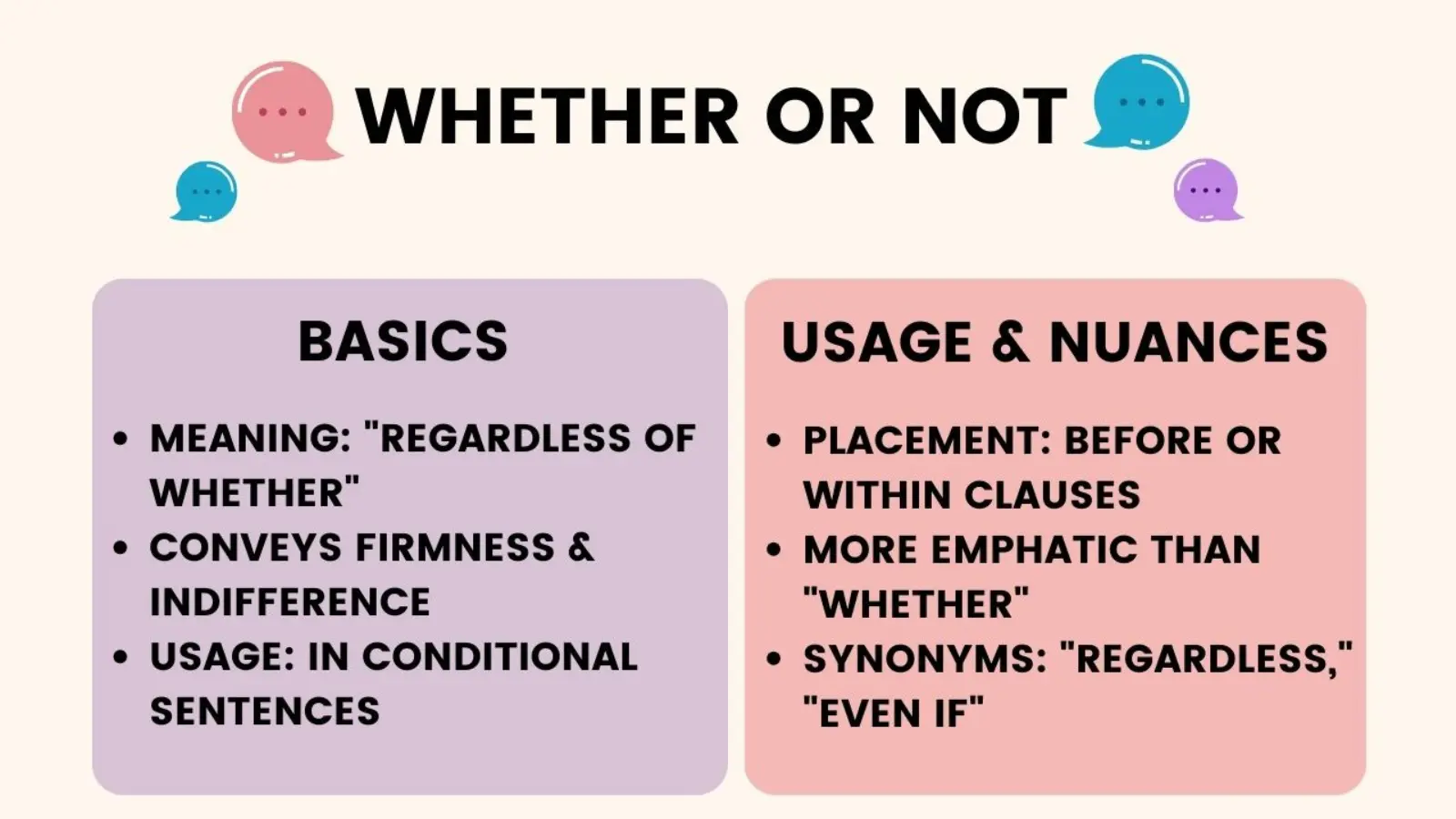
The phrase “whether or not” is used to express a condition where the outcome does not depend on a specific choice or situation.
In simple terms, it means “regardless of whether something happens.” People often search for “whether or not” to understand its correct usage, grammar rules, and differences from similar expressions like “if” or “whether.”
This phrase is widely used in both spoken and written English, especially in formal contexts, making it essential for students, writers, and professionals to use it correctly.
What Does “Whether or Not” Mean?
“Whether or not” is a conjunction phrase used to introduce alternatives or conditions where the result remains the same.
Simple Definition:
- It means “regardless of whether something happens or not.”
Example:
- I will go to the party whether or not you come.
This means the decision to go is independent of the other person’s choice.
How to Use “Whether or Not” Correctly
Understanding how to use “whether or not” properly can improve clarity in communication.
Common Sentence Structures
- At the beginning of a clause:
- Whether or not it rains, we will travel.
- In the middle of a sentence:
- She is unsure whether or not she should apply.
- At the end for emphasis:
- I am going to finish this, whether or not.
Whether vs If: Key Differences
Many people confuse “whether” and “if,” but they are not always interchangeable.
| Feature | Whether | If |
|---|---|---|
| Used with alternatives | Yes | Sometimes |
| Formal writing | Preferred | Less formal |
| With “or not” | Common | Rare |
| Prepositions | Allowed | Not allowed |
Example Comparison:
- Correct: I don’t know whether or not he will come.
- Less correct: I don’t know if or not he will come.
Why “Whether or Not” Is Important in English
The phrase adds clarity and precision, especially in complex sentences.
Key Benefits:
- Removes ambiguity
- Enhances formal writing
- Improves logical structure
- Useful in academic and professional communication
Common Mistakes to Avoid
Even fluent speakers make errors with “whether or not.”
Mistake 1: Using “if or not”
❌ I don’t know if or not she agrees.
✅ I don’t know whether or not she agrees.
Mistake 2: Redundancy
Sometimes “or not” is unnecessary.
- I don’t know whether she will come. (Correct)
- I don’t know whether or not she will come. (Also correct, but slightly redundant)
When to Use “Whether” Without “Or Not”
In many cases, “whether” alone is enough.
Examples:
- She asked whether he was ready.
- We need to decide whether we should continue.
Use “or not” when you want to emphasize both possibilities clearly.
Whether or Not in Formal Writing
“Whether or not” is commonly used in formal contexts such as:
- Academic essays
- Legal documents
- Business communication
Example:
- The results will be valid whether or not the hypothesis is correct.
Whether or Not in Spoken English
In everyday speech, people often shorten or simplify the phrase.
Examples:
- Are you coming or not? (Informal)
- Let me know whether or not you can attend. (Formal)
Examples of “Whether or Not” in Sentences
Everyday Examples:
- I’ll support you whether or not you succeed.
- She plans to travel whether or not she gets approval.
- We will proceed whether or not they agree.
Academic Examples:
- The experiment will continue whether or not initial results are positive.
Whether or Not vs Whether
Here’s a quick comparison:
| Usage | Whether | Whether or Not |
|---|---|---|
| Basic condition | ✔️ | ✔️ |
| Emphasis on both outcomes | ❌ | ✔️ |
| Formal tone | ✔️ | ✔️ |
| Clarity | Moderate | High |
Factors That Influence Usage
1. Context
Formal writing prefers “whether or not.”
2. Emphasis
Use “or not” when you want to stress both possibilities.
3. Clarity
In complex sentences, “whether or not” avoids confusion.
Whether or Not in Questions
The phrase is often used in indirect questions.
Examples:
- She asked whether or not he was available.
- I’m not sure whether or not this is correct.
Interesting Facts About “Whether or Not”
- It has been used in English for centuries.
- Common in legal language for clarity.
- Often appears in academic writing.
- Helps avoid ambiguity in complex sentences.
Whether or Not vs Alternatives
Alternatives:
- Regardless of
- Even if
- No matter if
Example:
- I will go whether or not it rains.
- I will go regardless of rain.
Frequently Asked Questions
1. What does “whether or not” mean?
It means “regardless of whether something happens” or “in either case.”
2. Can I use “whether” instead of “whether or not”?
Yes, but “whether or not” adds emphasis and clarity.
3. Is “if or not” correct?
No, it is grammatically incorrect. Use “whether or not.”
4. Is “whether or not” formal?
Yes, it is commonly used in formal writing and speech.
5. When should I use “or not”?
Use it when you want to clearly include both possibilities.
Conclusion
The phrase “whether or not” plays an important role in English by adding clarity, emphasis, and precision to sentences.
It helps express conditions where outcomes remain unchanged regardless of circumstances. Understanding how to use “whether or not” correctly can improve both written and spoken communication, especially in formal contexts.
By mastering its usage, avoiding common mistakes, and recognizing when it’s necessary, you can communicate more effectively. This is why “whether or not” remains a frequently searched and essential phrase for learners and professionals alike.

Emily is a social media enthusiast who loves turning everyday thoughts into viral captions. She brings a touch of charm and creativity to every post.