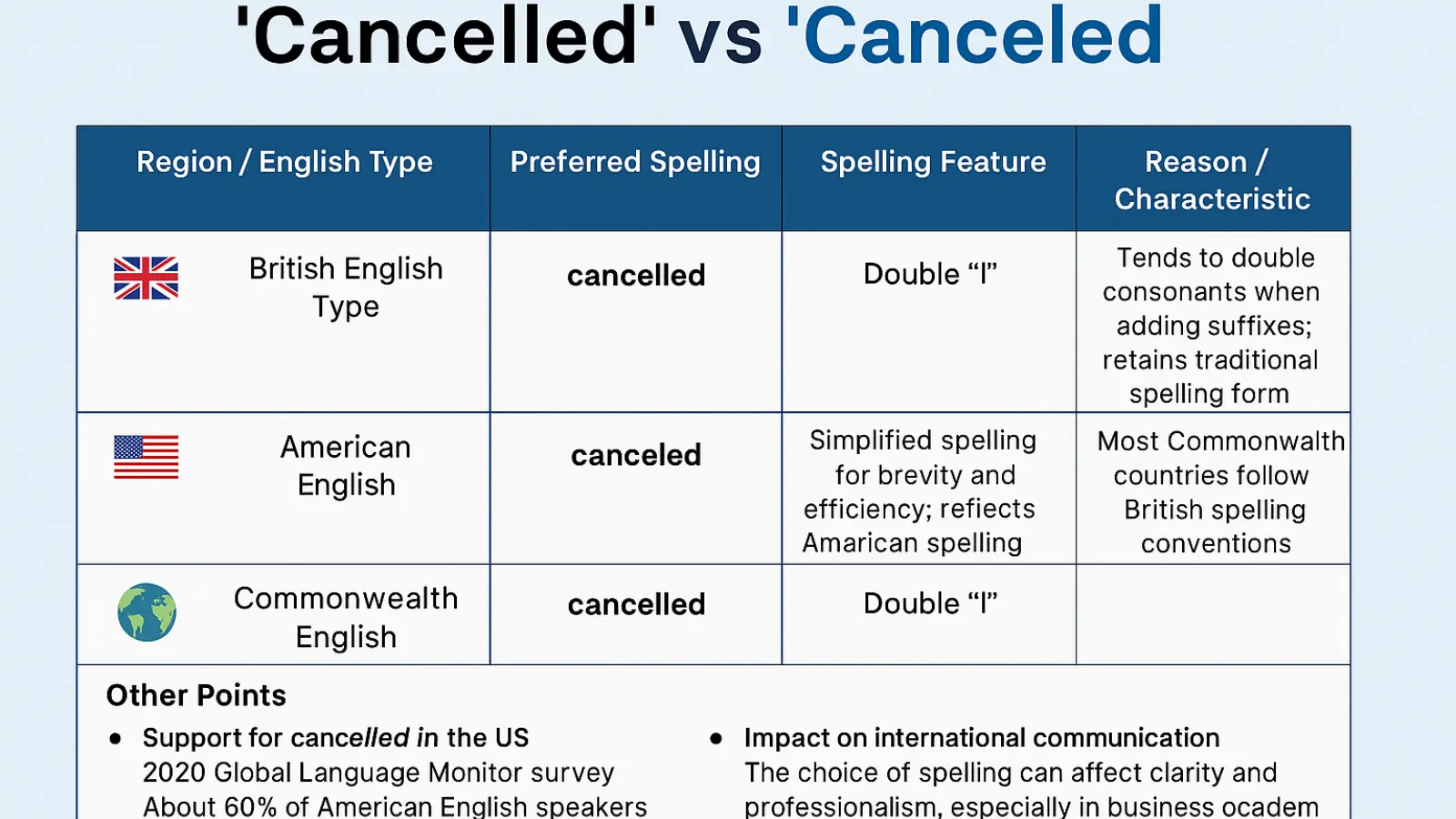
The difference between “canceled or cancelled” comes down to regional spelling rules. Both forms are correct, but “canceled” is preferred in American English, while “cancelled” is standard in British English.
This spelling variation exists because of differences in how words ending in “-l” are treated when adding suffixes like “-ed” or “-ing.”
Many people search for “canceled or cancelled” to ensure they are using the correct version in writing, especially in professional, academic, or online content. Understanding when and where to use each spelling helps improve clarity, credibility, and SEO performance.
Canceled or Cancelled: What’s the Difference?
The core difference between canceled or cancelled lies in geography and language conventions.
Key Rule:
- Canceled (one “l”) → American English
- Cancelled (two “l’s”) → British English
Both words mean the same thing: to call something off, stop it, or decide it will not happen.
Example Usage:
- American English: “The flight was canceled due to weather.”
- British English: “The match was cancelled because of rain.”
Why Do Two Spellings Exist?
The variation between canceled or cancelled is rooted in historical language development.
American English Simplification
American English tends to simplify spellings:
- Color (vs colour)
- Travel (vs travelled → traveling)
- Canceled (vs cancelled)
British English Consistency
British English follows a rule:
- When a verb ends in a vowel + “l,” double the “l” before adding suffixes.
So:
- Cancel → Cancelled
- Travel → Travelled
Canceled or Cancelled in 2026: Which Should You Use?
In 2026, both spellings remain correct, but usage depends on your audience.
Use “Canceled” If:
- You are writing for a US audience
- Your content follows American style guides (APA, Chicago)
- You are optimizing for US-based SEO
Use “Cancelled” If:
- Your audience is in the UK, Canada, Australia, or other Commonwealth countries
- You follow British English conventions
Canceled vs Cancelled: Quick Comparison Table
| Feature | Canceled (One L) | Cancelled (Two Ls) |
|---|---|---|
| Region | USA | UK, Canada, Australia |
| Language Style | American English | British English |
| Usage Popularity | High in US | High globally |
| Meaning | Same | Same |
| Grammar Rule | Simplified | Double consonant rule |
Why People Confuse “Canceled or Cancelled”
Many writers struggle with canceled or cancelled due to inconsistent exposure.
Common Reasons:
- Mixed exposure to US and UK content online
- Spell-check tools switching language settings
- Lack of awareness of regional rules
- Influence of global media
Grammar Rules Behind Canceled or Cancelled
American English Rule
In American English:
- Do not double the “l” if the stress is not on the final syllable.
Example:
- Cancel → Canceled
British English Rule
In British English:
- Double the “l” regardless of stress.
Example:
- Cancel → Cancelled
Related Word Forms
Understanding variations helps clarify canceled or cancelled further.
American English:
- Canceling
- Canceled
British English:
- Cancelling
- Cancelled
Canceled or Cancelled in SEO and Content Writing
Choosing between canceled or cancelled can impact SEO performance.
Keyword Strategy
- US audience → target “canceled”
- Global/UK audience → target “cancelled”
Best Practice
- Stay consistent throughout your content
- Avoid mixing both spellings in one article
- Choose based on your target region
Canceled or Cancelled in Voice Search
Voice search users often ask:
- “How do you spell canceled?”
- “Is cancelled correct?”
Optimization Tip:
Include natural phrases like:
- “how to spell canceled or cancelled”
- “difference between canceled and cancelled”
Examples in Real Sentences
American English:
- The event was canceled at the last minute.
- My subscription got canceled yesterday.
British English:
- The concert was cancelled unexpectedly.
- His appointment was cancelled due to illness.
Canceled or Cancelled vs Other Similar Words
Many words follow similar patterns:
| Base Word | American English | British English |
|---|---|---|
| Travel | Traveled | Travelled |
| Model | Modeled | Modelled |
| Cancel | Canceled | Cancelled |
Does It Matter Which One You Use?
Yes—especially in professional writing.
When It Matters:
- Academic papers
- Business communication
- SEO content
- Branding consistency
When It Doesn’t Matter:
- Casual texting
- Informal writing
Common Mistakes to Avoid
When dealing with canceled or cancelled, avoid these errors:
- Mixing both spellings in one document
- Using the wrong version for your audience
- Ignoring style guide rules
- Relying only on auto-correct
Interesting Facts About “Canceled or Cancelled”
- Both spellings date back centuries
- American English intentionally simplified spelling
- British English retains traditional forms
- “Cancelled” is more widely used globally
- Google recognizes both as correct
Canceled or Cancelled: Global Usage Trends
United States
- “Canceled” dominates search results
United Kingdom & Commonwealth
- “Cancelled” is standard
Internet Usage
- Both appear frequently due to global audiences
How to Remember the Difference
Simple Trick:
- USA = One L → Canceled
- UK = Two Ls → Cancelled
FAQ Section
1. Which is correct: canceled or cancelled?
Both are correct. “Canceled” is American English, while “cancelled” is British English.
2. How do you spell canceled in the US?
In American English, the correct spelling is canceled with one “l.”
3. Is cancelled wrong?
No, “cancelled” is correct in British English and widely used outside the US.
4. Why does cancelled have two Ls?
British English follows a rule of doubling the final “l” when adding suffixes.
5. Should I use canceled or cancelled for SEO?
Use “canceled” for US audiences and “cancelled” for UK/global audiences. Choose one and stay consistent.
Conclusion
The debate between canceled or cancelled isn’t about right or wrong—it’s about regional language differences. “Canceled” is the standard in American English, while “cancelled” is preferred in British English and many other parts of the world.
Both spellings carry the same meaning and are widely accepted, but choosing the correct one depends on your audience and writing style.
For SEO, branding, and professional communication, consistency is key. By understanding the rules and applying them correctly, you can write with confidence and clarity while avoiding common mistakes that confuse readers.
