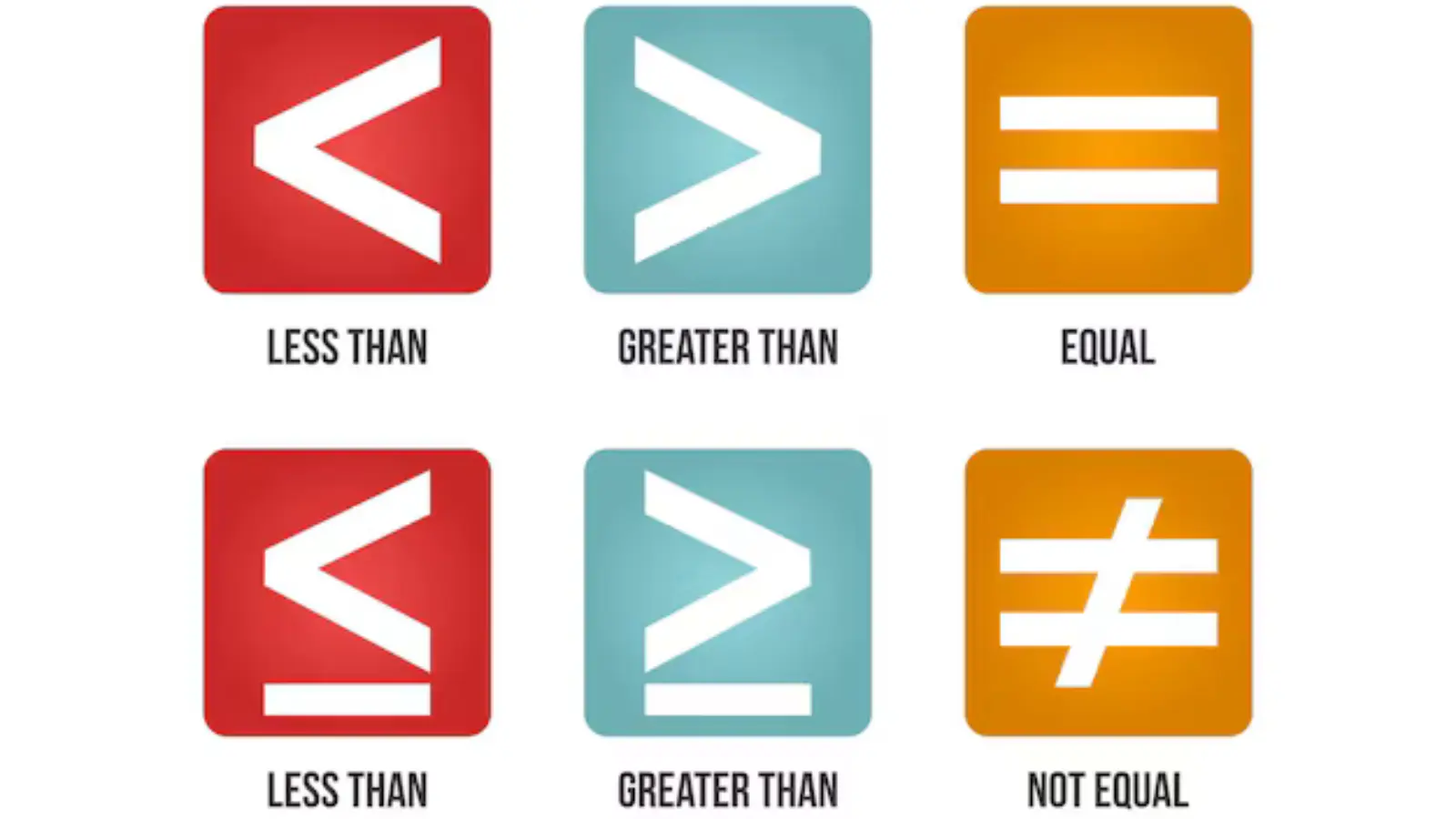
The less than or equal to symbol (≤) is one of the most commonly used mathematical comparison operators. It shows that one value is either smaller than another value or exactly equal to it.
People frequently search for less than or equal to because the symbol appears in mathematics, algebra, coding, Excel formulas, statistics, and everyday calculations.
Whether you are a student solving inequalities, a programmer writing conditions, or someone working with spreadsheets, understanding the less than or equal to operator is essential.
In simple terms, when you see a ≤ b, it means “a is less than b or equal to b.” This guide explains the meaning, symbol, examples, keyboard shortcuts, real-life uses, and comparisons in a clear and beginner-friendly way.
What Does Less Than or Equal To Mean?
The less than or equal to symbol combines two ideas:
- Less than (<)
- Equal to (=)
Together, they create the symbol:
≤
This means one number can either:
- Be smaller than another number
- Or be exactly the same
Example
5 ≤ 10This statement is true because 5 is smaller than 10.
Another example:
10 ≤ 10This is also true because 10 equals 10.
However:
15 ≤ 10This is false because 15 is greater than 10.
Less Than or Equal To Symbol Explained
The less than or equal to symbol looks like this:
≤
It is used in:
- Mathematics
- Algebra
- Statistics
- Computer programming
- Excel formulas
- Data analysis
- Scientific equations
How to Type the Less Than or Equal To Symbol
Many people search for how to type the less than or equal to sign on different devices.
On Windows
Press:
Alt + 243(using the numeric keypad)
On Mac
Press:
Option + ,On Microsoft Word
Go to:
- Insert
- Symbol
- Choose ≤
On Mobile Phones
Hold the “<” symbol on many keyboards to see extra options including:
≤Less Than or Equal To in Math
In mathematics, less than or equal to is mainly used in inequalities.
Basic Inequality Example
x ≤ 7This means:
- x can be 7
- or any number smaller than 7
Possible Values
| Value of x | True or False |
|---|---|
| 7 | True |
| 6 | True |
| 2 | True |
| 8 | False |
Difference Between Less Than and Less Than or Equal To
Many students confuse these two operators.
| Symbol | Meaning | Example |
|---|---|---|
| < | Less than | 5 < 10 |
| ≤ | Less than or equal to | 5 ≤ 10 |
| > | Greater than | 10 > 5 |
| ≥ | Greater than or equal to | 10 ≥ 5 |
Real-Life Examples of Less Than or Equal To
The less than or equal to operator is used in everyday life more often than people realize.
Age Restrictions
Children aged 12 or youngerThis can be written mathematically as:
Age ≤ 12Speed Limits
If a road sign says:
Maximum speed 60 mphThis means:
Speed ≤ 60Budget Planning
If you have a budget of $100:
Expenses ≤ 100Less Than or Equal To in Algebra
In algebra, inequalities are extremely important.
Example Problem
Solve:
x + 3 ≤ 10Step-by-Step Solution
Subtract 3 from both sides:
x ≤ 7This means x can be:
- 7
- 6
- 5
- or any smaller number
Graphing Less Than or Equal To on a Number Line
When graphing less than or equal to, you use:
- A closed circle
- A line extending left
Example
x ≤ 4Graph Explanation
- Closed dot at 4
- Shade all numbers smaller than 4
This shows 4 is included.
Less Than or Equal To vs Greater Than or Equal To
These symbols are opposites.
| Symbol | Meaning |
|---|---|
| ≤ | Less than or equal to |
| ≥ | Greater than or equal to |
Example
3 ≤ 8True because 3 is smaller.
8 ≥ 3Also true because 8 is greater.
Less Than or Equal To in Computer Programming
Programmers use the less than or equal to operator frequently.
Common Coding Symbol
In most programming languages:
<=represents less than or equal to.
Python Example
if age <= 18:
    print("Teenager")
JavaScript Example
if(score <= 50){
   console.log("Try Again");
}
Less Than or Equal To in Excel
Excel formulas often use the less than or equal to operator.
Example Formula
=IF(A1<=100,"Pass","Fail")This checks if the value in A1 is less than or equal to 100.
Less Than or Equal To in Statistics
Statistics uses inequalities for:
- Probability
- Data ranges
- Confidence intervals
- Statistical limits
Example
P(X ≤ 5)This means the probability that X is less than or equal to 5.
Why the Less Than or Equal To Symbol Matters
The less than or equal to operator is important because it helps define boundaries clearly.
It is used to:
- Set limits
- Compare values
- Solve equations
- Analyze data
- Build logical conditions
Without it, many mathematical and computer operations would be unclear.
Common Mistakes with Less Than or Equal To
Mixing Up Symbols
Some people confuse:
<with
≤Remember:
<excludes the number≤includes the number
Incorrect Direction
Example:
10 ≤ 5This is false because 10 is larger.
Forgetting Equality
The symbol also includes equality.
Example:
7 ≤ 7This is true.
Less Than or Equal To in Geometry
Geometry uses inequalities for:
- Angles
- Measurements
- Length comparisons
Example
Angle A ≤ 90°This means Angle A is either 90° or smaller.
Less Than or Equal To in Science
Science uses the operator for:
- Temperature ranges
- Chemical limits
- Physics formulas
Example
Temperature ≤ 100°CThis means the temperature must not exceed 100°C.
History of the Less Than or Equal To Symbol
The inequality symbols were introduced by mathematician:
Thomas Harriot
in the 1600s.
Over time, mathematicians combined symbols to create:
≤and
≥These became standard in mathematics worldwide.
Comparison Table: Common Math Symbols
| Symbol | Meaning | Example |
|---|---|---|
| = | Equal to | 5 = 5 |
| < | Less than | 3 < 8 |
| > | Greater than | 9 > 4 |
| ≤ | Less than or equal to | 5 ≤ 5 |
| ≥ | Greater than or equal to | 10 ≥ 7 |
| ≠ | Not equal to | 5 ≠ 3 |
Less Than or Equal To in Sets and Intervals
In interval notation:
Example
x ≤ 10can be written as:
(-∞, 10]The bracket means 10 is included.
How Students Can Easily Remember the Symbol
A simple trick:
The open side faces the larger number.
Example:
3 ≤ 8The wider opening points toward 8 because 8 is larger.
Practice Questions for Less Than or Equal To
Question 1
Is this true?
4 ≤ 6Answer
Yes.
Question 2
Is this true?
9 ≤ 9Answer
Yes, because both numbers are equal.
Question 3
Is this true?
12 ≤ 5Answer
No.
Less Than or Equal To in Daily Technology
Technology platforms use inequalities constantly.
Examples
- Search filters
- Age verification
- Shopping budgets
- Gaming scores
- Mobile apps
Example:
Battery ≤ 20%This triggers low-battery warnings.
Advantages of Understanding Less Than or Equal To
Learning the less than or equal to concept helps with:
- Faster math skills
- Better coding knowledge
- Improved spreadsheet use
- Stronger logical thinking
- Easier data analysis
Interesting Facts About Less Than or Equal To
- The symbol is used globally in mathematics.
- Coding languages usually use
<=instead of the actual symbol. - It is one of the first inequality symbols students learn.
- Scientific calculators include the operator in advanced functions.
- The symbol appears in AI, machine learning, and finance systems.
Less Than or Equal To in Competitive Exams
Many exams include inequalities.
Common Tests
- SAT
- GRE
- GMAT
- School algebra exams
- Engineering tests
Understanding less than or equal to can improve problem-solving speed.
Voice Search Optimized Questions
People often search using voice assistants like Siri or Google Assistant.
Common Voice Searches
- “What does less than or equal to mean?”
- “How do you type less than or equal to?”
- “What is the symbol for less than or equal to?”
- “How do inequalities work?”
- “What is the difference between less than and less than or equal to?”
Frequently Asked Questions (FAQ)
What does less than or equal to mean?
The less than or equal to symbol means one value is either smaller than another value or exactly equal to it.
What is the symbol for less than or equal to?
The symbol is:
≤How do you type less than or equal to on a keyboard?
- Windows:
Alt + 243 - Mac:
Option + ,
What is the difference between < and ≤?
<means strictly less than≤means less than OR equal to
Is 5 less than or equal to 5?
Yes.
5 ≤ 5is true because both numbers are equal.
How is less than or equal to used in programming?
Most programming languages use:
<=to represent the operator.
Can less than or equal to include negative numbers?
Yes.
Example:
-5 ≤ 2This is true because -5 is smaller than 2.
Why is less than or equal to important in math?
It helps compare numbers, solve inequalities, and define limits clearly.
Conclusion
The less than or equal to symbol (≤) is a powerful mathematical operator used in algebra, programming, Excel, statistics, and everyday life. It allows people to compare numbers while including equality in the comparison.
Whether you are solving equations, creating formulas, or analyzing data, understanding less than or equal to makes calculations and logical thinking much easier.
From school mathematics to advanced computer programming, this symbol plays a critical role across many fields.
Because of its importance and wide usage, people continue searching for the meaning, examples, and practical applications of less than or equal to online every day.
