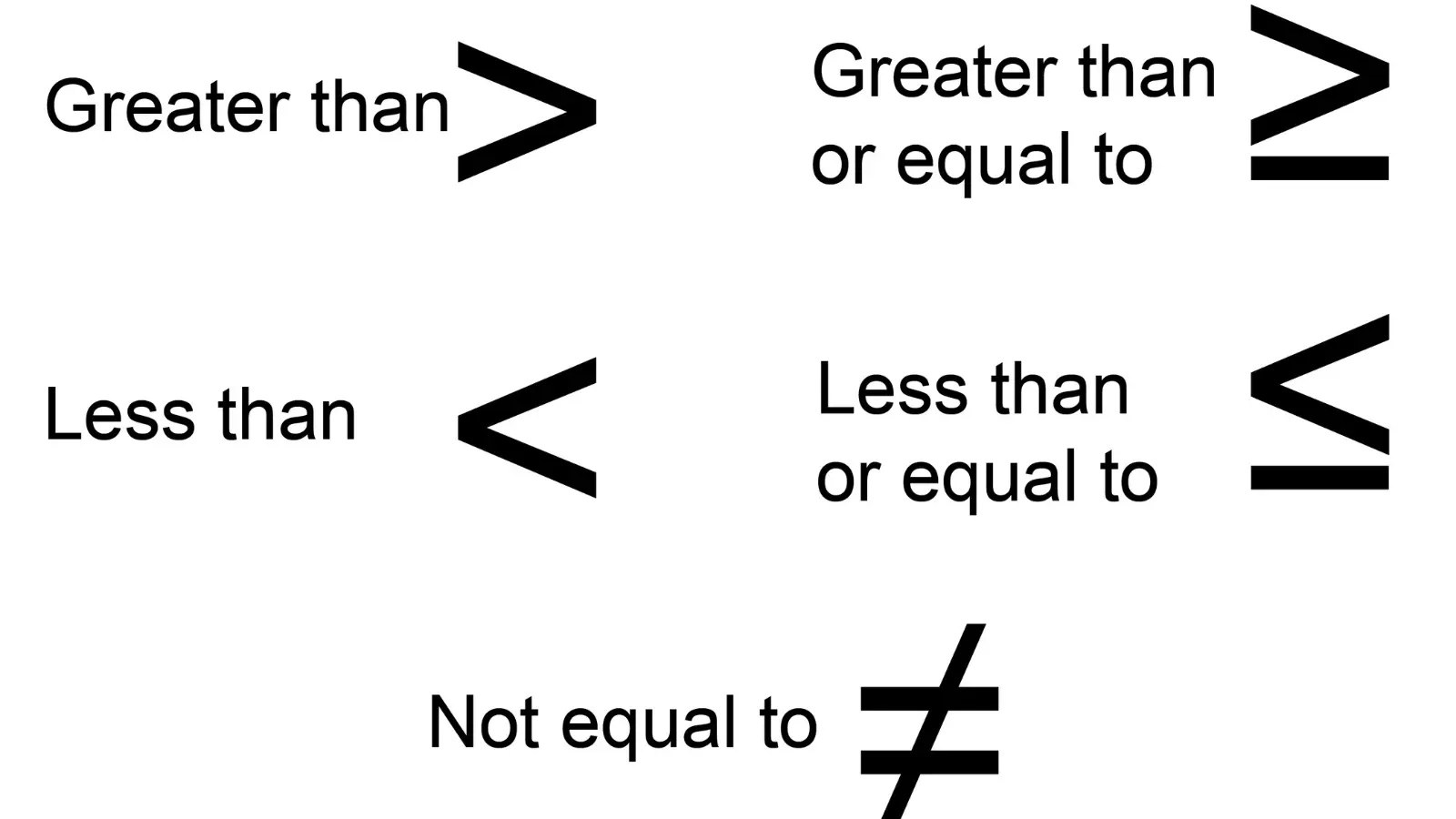
The greater than or equal to sign (≥) is a mathematical symbol used to show that one value is either larger than another value or exactly equal to it.
For example, in the expression x ≥ 10, the variable x can be any number greater than 10 or exactly 10.
People frequently search for the greater than or equal to sign because it appears in math classes, algebra, coding, Excel formulas, statistics, and scientific calculations.
Understanding this symbol is important for students, teachers, programmers, and professionals who work with numbers and logical comparisons daily.
In this guide, you’ll learn the meaning of the symbol, how to type it on different devices, where it is used, common mistakes, examples, and practical applications in real life.
What Is the Greater Than or Equal To Sign?
The greater than or equal to sign (≥) combines two mathematical ideas:
- Greater than (>)
- Equal to (=)
Together, they mean:
“A value is bigger than another value or exactly the same.”
Example
15 ≥ 10This statement is true because 15 is greater than 10.
Another example:
10 ≥ 10This is also true because the numbers are equal.
Greater Than or Equal To Sign Symbol
| Symbol | Meaning | Example |
|---|---|---|
| ≥ | Greater than or equal to | x ≥ 5 |
| ≤ | Less than or equal to | y ≤ 12 |
| > | Greater than | 9 > 4 |
| < | Less than | 2 < 8 |
The greater than or equal to sign is one of the most commonly used comparison symbols in mathematics and computer science.
How to Read the Greater Than or Equal To Sign
The symbol ≥ is read as:
- “Greater than or equal to”
- “At least”
- “No less than”
Examples
| Expression | Read As |
|---|---|
| x ≥ 7 | x is greater than or equal to 7 |
| Age ≥ 18 | Age is at least 18 |
| Score ≥ 90 | Score is 90 or higher |
Greater Than or Equal To Sign in Math
The greater than or equal to sign in math is used in:
- Algebra
- Geometry
- Statistics
- Calculus
- Inequalities
- Word problems
Algebra Example
x + 2 ≥ 10To solve:
x ≥ 8This means x can be:
- 8
- 9
- 10
- Any larger number
Greater Than or Equal To Sign on a Number Line
A number line helps visualize inequalities.
For:
x ≥ 3- Put a closed circle on 3
- Shade everything to the right
The closed circle means 3 is included.
Difference Between > and ≥
Many people confuse these symbols.
| Symbol | Meaning | Includes Equal Value? |
|---|---|---|
| > | Greater than | No |
| ≥ | Greater than or equal to | Yes |
Example
5 > 5 → False
5 ≥ 5 → True
The second statement is true because the values are equal.
How to Type the Greater Than or Equal To Sign
Many users search for how to type the greater than or equal to sign on different devices.
On Windows
Press:
Alt + 242using the numeric keypad.
You can also copy and paste:
≥On Mac
Press:
Option + .On Chromebook
Use:
Ctrl + Shift + UThen type:
2265and press Enter.
On iPhone and Android
- Hold the greater than symbol (>)
- Select ≥ from the popup menu
Greater Than or Equal To Sign in Word
In Microsoft Word:
- Type
2265 - Press
Alt + X
It converts into:
≥Greater Than or Equal To Sign in Excel
The greater than or equal to sign in Excel is very common in formulas.
Example Formula
=IF(A1>=50,"Pass","Fail")This means:
- If the value in A1 is 50 or more → Pass
- Otherwise → Fail
Excel Uses
The symbol helps with:
- Conditional formatting
- Financial calculations
- Data filtering
- Reports
- Grades and scoring
Greater Than or Equal To Sign in Programming
The greater than or equal to sign is heavily used in coding.
Common Programming Languages
| Language | Example |
|---|---|
| Python | if x >= 10: |
| JavaScript | if(score >= 80) |
| Java | while(age >= 18) |
| C++ | if(a >= b) |
Why Programmers Use It
It helps compare values and make decisions in code.
Example
if marks >= 90:
    print("Excellent")
Real-Life Uses of the Greater Than or Equal To Sign
The symbol appears in many everyday situations.
Age Requirements
Age ≥ 18Means people must be 18 or older.
Speed Limits
Speed ≥ 60 mphShows speeds equal to or above 60.
Budget Planning
Savings ≥ $1000Means savings should be at least $1000.
Science and Statistics
Scientists use inequalities in:
- Measurements
- Research
- Probability
- Data analysis
Greater Than or Equal To Sign Examples
Here are some simple examples.
| Expression | True or False |
|---|---|
| 12 ≥ 10 | True |
| 5 ≥ 5 | True |
| 3 ≥ 9 | False |
| 100 ≥ 99 | True |
Word Problem Examples
Example 1
A movie ticket is allowed for people aged 13 or older.
Age ≥ 13Example 2
You need at least 70 marks to pass.
Marks ≥ 70Greater Than or Equal To Sign vs Less Than or Equal To Sign
These two symbols are opposites.
| Symbol | Meaning |
|---|---|
| ≥ | Greater than or equal to |
| ≤ | Less than or equal to |
Example
x ≥ 5Means x is 5 or more.
x ≤ 5Means x is 5 or less.
Common Mistakes With the Greater Than or Equal To Sign
People often make small errors when using the symbol.
1. Confusing > and ≥
Remember:
>does not include equality≥includes equality
2. Reversing the Symbol
5 ≥ 3 → Correct
3 ≥ 5 → Incorrect
The larger value should be on the left.
3. Using the Wrong Direction
Think of the symbol as an alligator mouth:
- It opens toward the bigger number.
Why the Greater Than or Equal To Sign Matters
The greater than or equal to sign is essential because it helps:
- Compare quantities
- Define limits
- Solve equations
- Build computer programs
- Analyze data
Without inequality symbols, many mathematical and logical systems would not work properly.
Greater Than or Equal To Sign in Education
Students learn this symbol early in school because it builds the foundation for:
- Algebra
- Graphing
- Calculus
- Problem-solving
Teachers often use visual methods like:
- Number lines
- Charts
- Interactive games
to explain inequalities.
History of the Greater Than or Equal To Sign
Mathematical symbols developed over centuries to simplify communication.
The greater than symbol (>) was introduced by mathematician Thomas Harriot in the 1600s. Later, mathematicians combined it with the equal sign to create the modern greater than or equal to sign (≥).
Today, it is universally recognized in:
- Mathematics
- Technology
- Science
- Engineering
Greater Than or Equal To Sign in Statistics
Statistics uses inequalities frequently.
Example
p ≥ 0.05This may appear in hypothesis testing.
Researchers also use it in:
- Confidence intervals
- Data analysis
- Probability models
Greater Than or Equal To Sign in Graphs
Graphs often include inequalities.
For:
y ≥ 2- Draw a solid line at y = 2
- Shade the area above the line
The solid line means the value 2 is included.
Keyboard Shortcuts for the Greater Than or Equal To Sign
| Device | Shortcut |
|---|---|
| Windows | Alt + 242 |
| Mac | Option + . |
| HTML | ≥ |
| Unicode | U+2265 |
Greater Than or Equal To Sign in HTML
Web developers use HTML entities.
Example
≥Displays as:
≥Greater Than or Equal To Sign in LaTeX
Students and researchers using LaTeX write:
\geqThis produces:
≥Fun Facts About the Greater Than or Equal To Sign
- It is one of the most used inequality symbols worldwide.
- It appears in school textbooks from elementary to university level.
- Coding languages rely heavily on it for logical operations.
- Search interest for the greater than or equal to sign increases during exam seasons.
- It is commonly used in AI, machine learning, and data science.
Comparison Table: Common Math Symbols
| Symbol | Name | Meaning |
|---|---|---|
| = | Equal to | Same value |
| > | Greater than | Larger value |
| < | Less than | Smaller value |
| ≥ | Greater than or equal to | Larger or same |
| ≤ | Less than or equal to | Smaller or same |
| ≠ | Not equal to | Different values |
Practical Exercises
Try solving these.
Exercise 1
8 ≥ 4Answer: True
Exercise 2
2 ≥ 7Answer: False
Exercise 3
x ≥ 12Possible values:
- 12
- 13
- 20
- 100
Frequently Asked Questions (FAQ)
What does the greater than or equal to sign mean?
The greater than or equal to sign (≥) means one value is either larger than another value or exactly equal to it.
How do you type the greater than or equal to sign?
You can type it using keyboard shortcuts like:
- Windows: Alt + 242
- Mac: Option + .
You can also copy and paste: ≥
What is the difference between > and ≥?
>means only greater than≥means greater than or equal to
Example:
5 > 5 → False
5 ≥ 5 → True
Where is the greater than or equal to sign used?
It is used in:
- Mathematics
- Excel
- Coding
- Statistics
- Science
- Finance
What is the opposite of the greater than or equal to sign?
The opposite symbol is:
≤which means less than or equal to.
Is 10 greater than or equal to 10?
Yes.
10 ≥ 10is true because the numbers are equal.
Why is the greater than or equal to sign important?
It helps compare values accurately and is essential in equations, programming, data analysis, and logical reasoning.
Conclusion
The greater than or equal to sign (≥) is a powerful mathematical symbol used to compare values that are either larger or equal.
From algebra and statistics to Excel formulas and computer programming, this symbol plays an important role in solving problems and making logical comparisons.
Understanding how to read, type, and use the greater than or equal to sign can improve math skills, coding knowledge, and analytical thinking.
Whether you are a student, teacher, programmer, or professional, mastering this symbol makes working with numbers easier and more accurate.
Its widespread use across education, technology, and science explains why so many people search for the greater than or equal to sign online every day.

-
Daniel writes captions that connect. With a love for words and culture, he brings depth, wit, and fresh perspective to social media content.