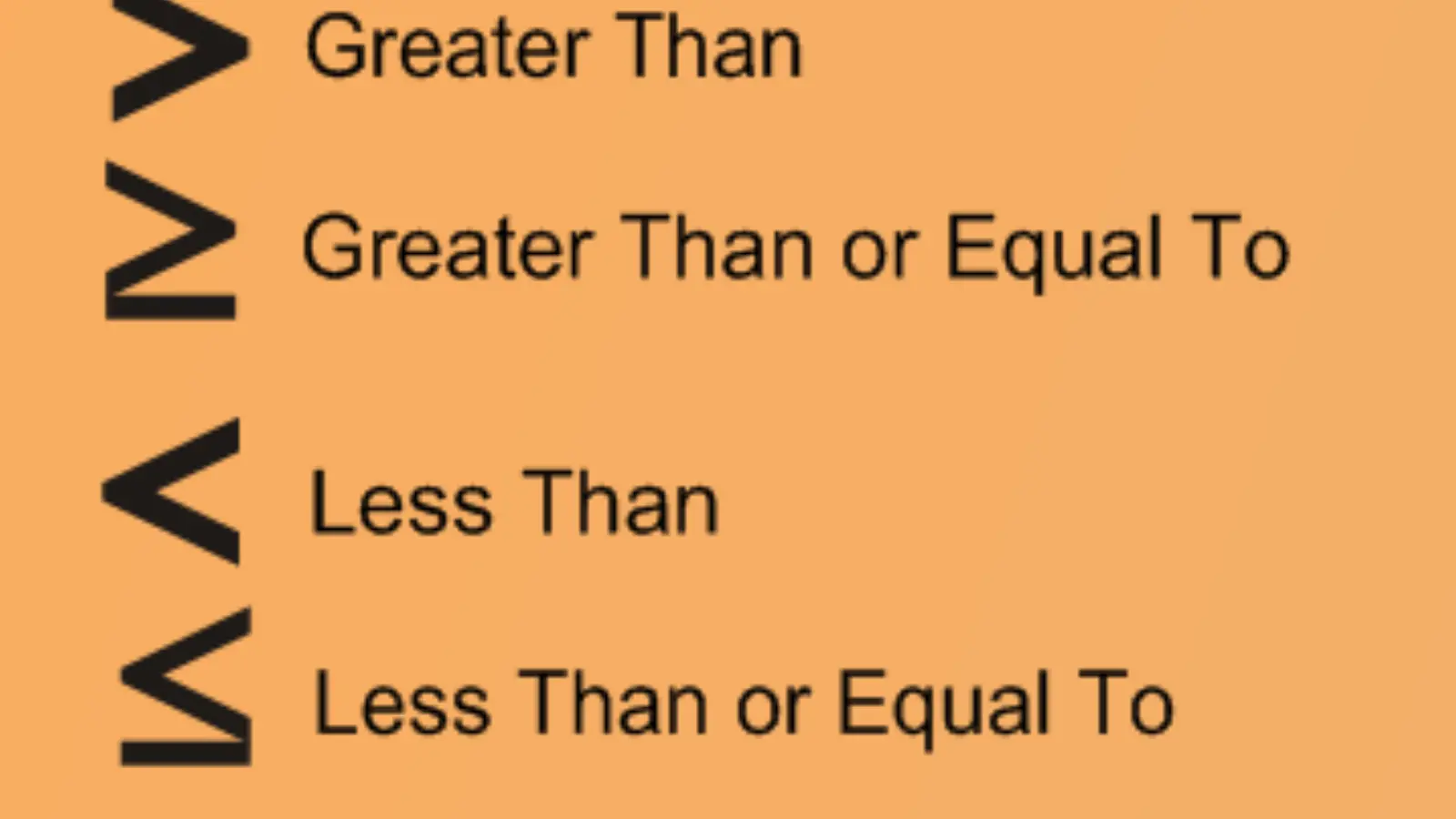
The greater than or equal to symbol (≥) is one of the most commonly used mathematical comparison operators.
It shows that one number is either larger than another number or exactly equal to it. For example, if we write x ≥ 5, it means that x can be 5 or any number bigger than 5.
People frequently search for “greater than or equal to” because the symbol appears in algebra, programming, Excel formulas, statistics, economics, and real-life calculations.
Understanding how this operator works makes solving equations, interpreting data, and writing formulas much easier.
Whether you are a student, teacher, programmer, or someone working with spreadsheets, this complete guide explains everything about the greater than or equal to symbol in a simple and practical way.
What Does Greater Than or Equal To Mean?
The greater than or equal to symbol combines two ideas:
- Greater than (>)
- Equal to (=)
When combined, they create the symbol:
≥
This symbol means:
- A value is larger than another value
- OR
- The value is exactly equal to it
Example
10≥510 ≥ 5 10≥5
This statement is true because 10 is greater than 5.5≥55 ≥ 5 5≥5
This is also true because both numbers are equal.3≥73 ≥ 7 3≥7
This statement is false because 3 is not greater than or equal to 7.
Greater Than or Equal To Symbol Explained
The greater than or equal to symbol looks like this:
≥
It consists of:
- A “greater than” sign (>)
- A line underneath showing “equal to”
This tells us that both conditions are acceptable.
| Symbol | Meaning |
|---|---|
| > | Greater than |
| < | Less than |
| ≥ | Greater than or equal to |
| ≤ | Less than or equal to |
| = | Equal to |
How to Type the Greater Than or Equal To Symbol
Many users search for ways to type the greater than or equal to symbol on different devices.
On Windows
Hold:
Alt + 242(using the numeric keypad)
On Mac
Press:
Option + .On Microsoft Word
Type:
2265Then press:
Alt + XIt automatically changes into:
≥On Mobile Phones
- Open the keyboard
- Hold the “greater than” sign (>)
- Choose the ≥ symbol
Greater Than or Equal To in Math
The greater than or equal to operator is widely used in mathematics.
Inequalities
It commonly appears in inequalities.
Example:
x≥12x ≥ 12 x≥12
This means:
- x can equal 12
- x can also be any number larger than 12
Possible values:
- 12
- 13
- 20
- 100
Not allowed:
- 11
- 5
- -2
Solving Greater Than or Equal To Inequalities
Example 1
x+3≥10x + 3 ≥ 10 x+3≥10
Subtract 3 from both sides:x≥7x ≥ 7 x≥7
Answer:
Any number greater than or equal to 7 works.
Example 2
2x≥182x ≥ 18 2x≥18
Divide both sides by 2:x≥9x ≥ 9 x≥9
Graphing Greater Than or Equal To on a Number Line
When graphing greater than or equal to, use:
- A closed circle
- Shade toward the right
Example
x≥4x ≥ 4 x≥4
Graph:
- Closed circle on 4
- Arrow extending right
The closed circle shows that 4 is included.
Greater Than or Equal To in Algebra
Algebra heavily relies on the greater than or equal to operator.
Example Equation
5x−2≥135x – 2 ≥ 13 5x−2≥13
Add 2:5x≥155x ≥ 15 5x≥15
Divide by 5:x≥3x ≥ 3 x≥3
Greater Than or Equal To in Real Life
Many people do not realize how often they use greater than or equal to situations daily.
Age Requirements
Age ≥ 18Means:
- 18-year-olds allowed
- Older people allowed
Minimum Score Requirements
Score ≥ 70Means:
- 70 passes
- Any higher score also passes
Shopping Discounts
Purchase ≥ $100Means:
- Spend $100 or more to qualify
Greater Than or Equal To in Programming
Programmers use greater than or equal to in nearly every coding language.
Common Syntax
| Language | Operator |
|---|---|
| Python | >= |
| JavaScript | >= |
| Java | >= |
| C++ | >= |
Python Example
age = 18

if age >= 18:
    print("Adult")
This checks whether age is greater than or equal to 18.
JavaScript Example
if(score >= 90){
   console.log("Excellent");
}
Greater Than or Equal To in Excel
Excel formulas commonly use the greater than or equal to operator.
Formula Example
=IF(A1>=50,"Pass","Fail")This formula checks:
- If A1 is 50 or higher → Pass
- Otherwise → Fail
Greater Than or Equal To vs Greater Than
Many students confuse these symbols.
Key Difference
| Symbol | Meaning |
|---|---|
| > | Strictly larger |
| ≥ | Larger OR equal |
Example Comparison
Greater Than
x>5x > 5 x>5
Possible values:
- 6
- 7
- 10
Not allowed:
- 5
Greater Than or Equal To
x≥5x ≥ 5 x≥5
Possible values:
- 5
- 6
- 10
Greater Than or Equal To vs Less Than or Equal To
These are opposite operators.
| Symbol | Meaning |
|---|---|
| ≥ | Greater than or equal to |
| ≤ | Less than or equal to |
Example
x≥8x ≥ 8 x≥8
Means 8 or more.x≤8x ≤ 8 x≤8
Means 8 or less.
Common Mistakes With Greater Than or Equal To
Understanding the greater than or equal to symbol becomes easier when you avoid common mistakes.
Mistake 1: Forgetting Equality
Many people think:x≥5x ≥ 5 x≥5
Means only values above 5.
Actually, 5 itself is included.
Mistake 2: Using Open Circles on Graphs
For greater than or equal to, always use:
- Closed circle
Not open circle.
Mistake 3: Reversing the Symbol
5≥35 ≥ 3 5≥3
Correct.3≥53 ≥ 5 3≥5
Incorrect.
Why Greater Than or Equal To Is Important
The greater than or equal to concept appears in many fields.
Education
Used in:
- Algebra
- Geometry
- Calculus
- Statistics
Business
Used for:
- Sales targets
- Financial analysis
- Budget requirements
Technology
Used in:
- Software development
- Algorithms
- Data filtering
Science
Used in:
- Measurements
- Research comparisons
- Experimental limits
Greater Than or Equal To in Statistics
Statistics frequently uses the greater than or equal to symbol.
Example
P(x≥10)P(x ≥ 10) P(x≥10)
This means:
Probability that x is 10 or higher.
Greater Than or Equal To in Set Notation
Set builders use this symbol often.
Example
x∣x≥0{x | x ≥ 0} x∣x≥0
This represents:
All numbers greater than or equal to zero.
Greater Than or Equal To in Geometry
Geometry uses inequalities to describe shapes and measurements.
Example
Angle≥90°Angle ≥ 90° Angle≥90°
Means:
The angle is 90 degrees or larger.
Greater Than or Equal To in Economics
Economists use inequalities for:
- Income thresholds
- Budget constraints
- Production goals
Example
Revenue ≥ ExpensesMeans the business is profitable or balanced.
Greater Than or Equal To Symbol History
The greater than or equal to notation developed from traditional inequality symbols used in mathematics during the 17th century.
Mathematicians needed ways to express:
- Comparisons
- Ranges
- Conditions
The combined symbol became a universal mathematical standard.
Easy Tricks to Remember the Symbol
A helpful trick:
The open side faces the larger value.
Example
9≥49 ≥ 4 9≥4
The symbol opens toward 9 because 9 is larger.
Another memory tip:
- The line underneath means “or equal to.”
Examples of Greater Than or Equal To
Basic Examples
| Statement | True or False |
|---|---|
| 8 ≥ 5 | True |
| 5 ≥ 5 | True |
| 2 ≥ 9 | False |
| 15 ≥ 10 | True |
Algebra Examples
| Inequality | Solution |
|---|---|
| x ≥ 4 | 4 or more |
| y ≥ -2 | -2 or more |
| z ≥ 100 | 100 or higher |
Greater Than or Equal To Practice Problems
Problem 1
x+2≥7x + 2 ≥ 7 x+2≥7
Answer:x≥5x ≥ 5 x≥5
Problem 2
3x≥123x ≥ 12 3x≥12
Answer:x≥4x ≥ 4 x≥4
Problem 3
10≥y10 ≥ y 10≥y
This means:y≤10y ≤ 10 y≤10
Advanced Uses of Greater Than or Equal To
Advanced mathematics uses inequalities in:
- Calculus
- Linear programming
- Optimization
- Artificial intelligence
- Machine learning
Calculus Example
f(x)≥0f(x) ≥ 0 f(x)≥0
Means the function remains positive or zero.
Greater Than or Equal To in Data Analysis
Data analysts use filters such as:
Sales ≥ 500This helps find records meeting minimum requirements.
Greater Than or Equal To in SQL
SQL databases use this operator frequently.
Example
SELECT * FROM employees
WHERE salary >= 50000;
This retrieves employees earning $50,000 or more.
Comparison Table: Math Operators
| Operator | Name | Example |
|---|---|---|
| > | Greater than | 7 > 4 |
| < | Less than | 2 < 9 |
| ≥ | Greater than or equal to | 5 ≥ 5 |
| ≤ | Less than or equal to | 3 ≤ 8 |
| = | Equal to | 6 = 6 |
Interesting Facts About Greater Than or Equal To
- It is one of the most searched math symbols online.
- Used in almost every programming language.
- Essential in spreadsheet formulas.
- Appears in entrance exams and competitive tests.
- Frequently used in AI algorithms and machine learning.
Frequently Asked Questions (FAQ)
What does greater than or equal to mean?
The greater than or equal to symbol means a value is either larger than another value or exactly equal to it.
What is the symbol for greater than or equal to?
The symbol is:
≥How do you type the greater than or equal to symbol?
You can type it using:
- Windows: Alt + 242
- Mac: Option + .
- Word: 2265 + Alt + X
Is 5 greater than or equal to 5?
Yes. Since both numbers are equal, the statement is true.
What is the difference between > and ≥?
- > means strictly greater
- ≥ means greater OR equal
How is greater than or equal to used in programming?
Programming languages use:
>=To compare values in conditions and logic statements.
What does x ≥ 10 mean?
It means x can be:
- 10
- Any number larger than 10
Is greater than or equal to used in Excel?
Yes. Excel formulas commonly use:
>=For conditions and calculations.
Conclusion
The greater than or equal to symbol (≥) is one of the most important comparison operators in mathematics, programming, Excel, and real-world problem-solving.
It represents values that are either larger than another value or exactly equal to it.
From algebra equations and data analysis to coding and financial calculations, this symbol appears almost everywhere. Understanding how to use greater than or equal to correctly makes solving inequalities, interpreting formulas, and comparing values much easier.
Whether you are a student, teacher, programmer, or business professional, mastering this symbol helps build a strong foundation in mathematics and logical thinking.
